How Far Is Mars From The Sun

There is something profoundly humbling and exhilarating about gazing at the night sky and knowing that a faint red dot is a whole world, orbiting our Sun. Understanding the di...

There is something profoundly humbling and exhilarating about gazing at the night sky and knowing that a faint red dot is a whole world, orbiting our Sun. Understanding the distances in our solar system isn’t just an academic exercise; it feeds a deep human curiosity about our place in the cosmos. For stargazers, students, and dreamers alike, knowing how far Mars is from the Sun transforms a simple point of light into a real, tangible place—a neighboring planet with seasons, volcanoes, and the potential for ancient life. This knowledge helps us appreciate the sheer scale of our celestial neighborhood, making our own Earth feel both more precious and less lonely.
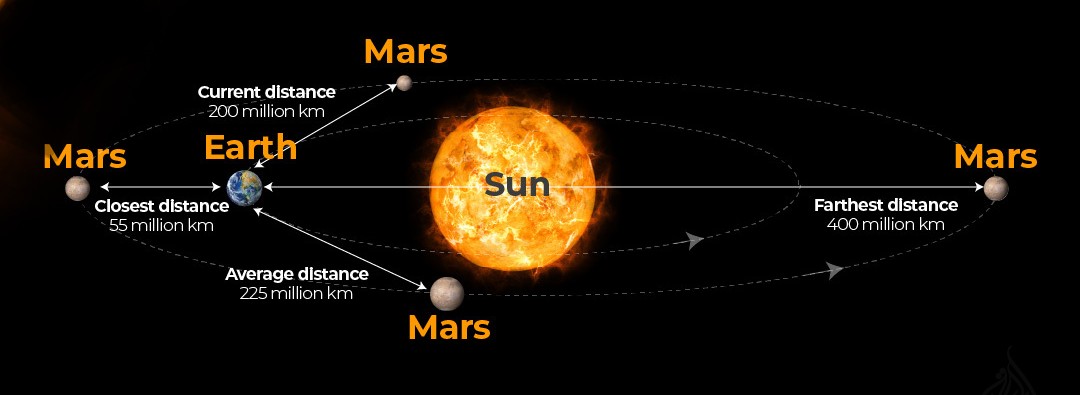
The core purpose of measuring this distance is to grasp the mechanics of our solar system. Mars orbits the Sun in an elliptical path, meaning its distance is not constant. At its closest point, or perihelion, Mars is approximately 128 million miles (206 million kilometers) from the Sun. At its farthest, or aphelion, that distance swells to about 154 million miles (249 million kilometers). This variation of roughly 26 million miles is the reason why some Mars missions launch at very specific times—during an "opposition" when Mars and Earth are aligned—to minimize travel time and fuel.
This distance directly impacts our everyday lives in surprising ways. For instance, the time it takes for a signal to travel from Earth to a rover on Mars—like Perseverance—varies from about 3 to 22 minutes, depending on their positions. That delay is a direct consequence of the Sun-Mars distance. Imagine trying to drive a car on another planet with a 20-minute lag on steering commands; it forces engineers to build rovers that can think for themselves. Furthermore, the amount of sunlight Mars receives is only about 43% of what Earth gets, which dictates the design of its solar panels and the harshness of its climate.
Must Read
Consider the scenario of planning a future human mission. Astronauts heading to Mars would face a journey of nearly seven months, a direct result of that 128-to-154-million-mile orbit. The distance dictates everything about their survival: the amount of food, water, and radiation shielding they need. It also creates a profound psychological challenge—the crew will be farther from home than any human in history, with Earth shrinking to a small blue dot. This isn't abstract; it is the core constraint of exploration.
 PPT - Planets Distances and Scientific Notation PowerPoint Presentation
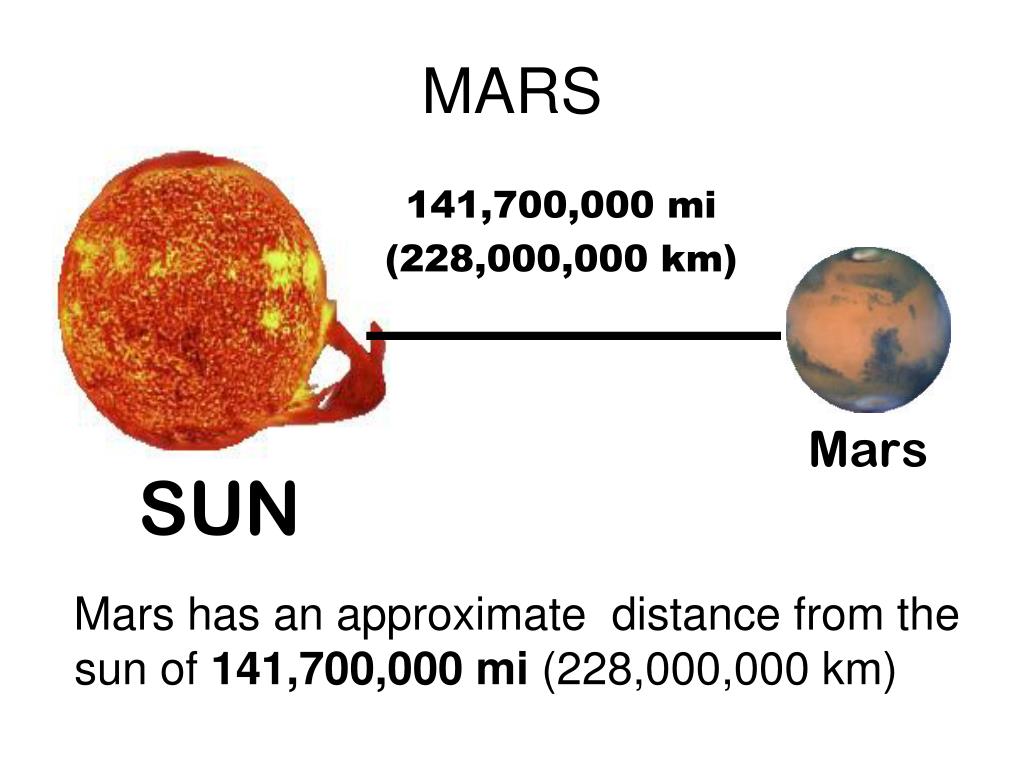
For those who want to explore this distance on their own, start with a simple model. Grab a ball (representing the Sun) and a peppercorn (Mars) and place them about 27 feet apart to scale the average distance. This will instantly show you how empty space really is. Next, use a free astronomy app like Stellarium or SkySafari; search for Mars and toggle the "distance from Sun" display. Finally, visit NASA's Eyes on the Solar System website to watch a real-time visualization of Mars speeding along its orbit, making that vast number feel dynamic and alive.
Ultimately, the distance between Mars and the Sun is more than a number—it is a key that unlocks our understanding of planetary science, fuels our engineering limits, and defines the rhythm of space exploration. It reminds us that even the nearest worlds require immense effort to reach, and yet, that effort is what drives innovation here on Earth.