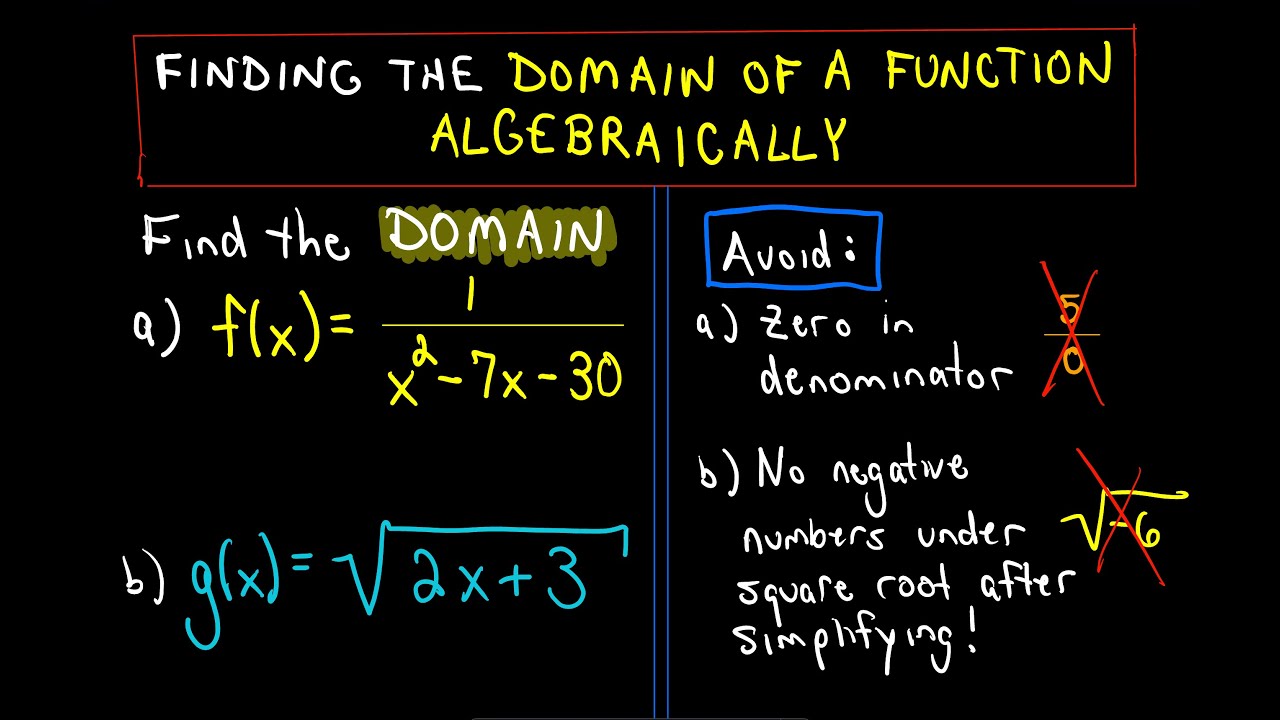
How To Find The Domain Algebraically

There is a quiet satisfaction in understanding how a mathematical function behaves before you even plug in a single number. Finding the domain of a function algebraically is l...
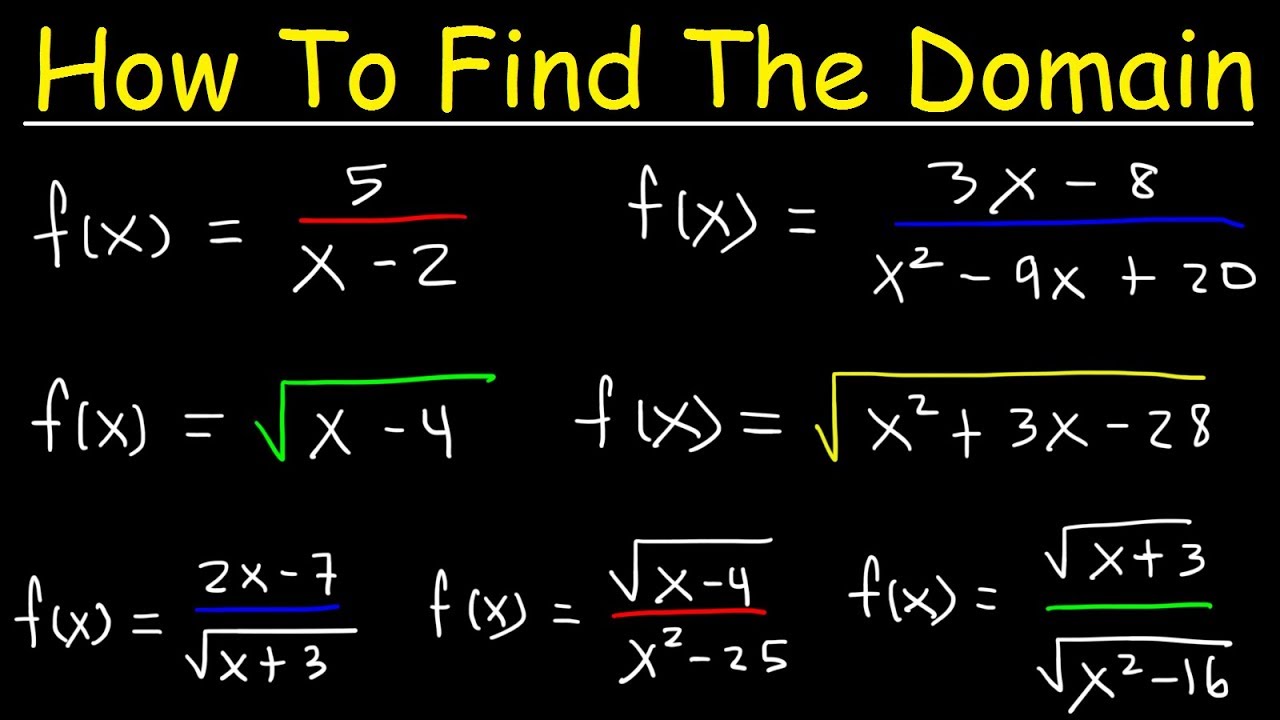
There is a quiet satisfaction in understanding how a mathematical function behaves before you even plug in a single number. Finding the domain of a function algebraically is like being a detective for a puzzle: you get to uncover the hidden boundaries where the function makes sense. This skill transforms an abstract expression into a concrete, trustworthy tool, and it empowers you to avoid errors in everything from engineering calculations to budgeting spreadsheets.
At its core, the domain is simply the set of all input values (usually \( x \)) that produce a real, valid output. Think of it as the guest list for a party: you need to know who is allowed in. For example, if you are calculating the cost of renting a bike for \( x \) hours, the domain would exclude negative hours. The key purpose here is to prevent undefined or meaningless results—a critical step when you rely on mathematical models for real-world decisions.
The most common pitfalls come from two main culprits: division by zero and even roots of negatives. Imagine you are a chef calculating the number of pies (\( P \)) you can make from \( x \) pounds of flour, using the formula \( P(x) = \frac{12}{x-3} \). If \( x = 3 \), you have zero in the denominator—this would be like asking to divide pies by nothing. Algebraically, you set the denominator equal to zero, solve \( x - 3 = 0 \), and exclude \( x = 3 \) from the domain. Similarly, consider a formula for the time it takes to fill a tank, \( t(x) = \sqrt{x-5} \). Inside a square root, you cannot have a negative number in the real world. You set the inside \( x-5 \geq 0 \), solving to \( x \geq 5 \).
Must Read
These principles are not just for classrooms; they have everyday benefits. When you use a formula to estimate the safe dosage of a medicine based on weight, or to calculate the break-even point for a small business, the domain ensures you do not enter nonsensical values. It acts as a safety net, catching errors before they lead to faulty conclusions. For instance, if a quadratic function models your phone’s battery life over hours, the domain tells you that using it for a negative number of hours is meaningless.
Here are a few simple tips to explore domain-finding on your own. First, always check for fractions: set the denominator not equal to zero and solve. Second, for square roots (or any even root), set the radicand (the inside part) greater than or equal to zero. Third, write your final answer in interval notation (like \( (-\infty, 3) \cup (3, \infty) \)) to clearly show the allowed values. Practice with simple functions like \( \frac{1}{x-2} \) or \( \sqrt{7-x} \), and always ask: “Does this input break the rules of math?”
 6 Ways to Find the Domain of a Function - wikiHow
Remember that domain-finding is a skill of exclusion, not inclusion. Start with all real numbers, then carefully remove the troublemakers—like a bouncer removing guests who cause chaos. Over time, this process becomes intuitive, turning a confusing formula into a clear boundary. Embrace the detective work, and you will gain confidence in every equation you encounter, from algebra homework to real-world problem-solving.
Ultimately, mastering the domain algebraically gives you the power to trust your numbers. Whether you are optimizing a recipe, analyzing a budget, or building a model for a science project, this simple algebraic check ensures you work only with valid inputs. It is a small, elegant guardrail that keeps your reasoning sound—and that is a skill worth cherishing.